
THE AGE OF ARTIFICIAL intelligence dawned as I was still learning to write fiction.
It turned out to be the perfect time to launch my new career and publish my first novel. In fact, the timing could not have been better from a business perspective.
The process has been an ideal fusing of my existing technical knowledge with a groundbreaking new instructional and coding application. This combination has resulted in a website with features I could never have constructed on my own.
In the process, I’ve come to understand the nature of AI as it applies to selling my first novel, The Sacred Cycle. That understanding has resulted in some specific features of my website that you’re likely to encounter.
I’ve been very fortunate to catch a wave as it’s first forming. Learning why and how I’ve created these features will help you decide if something similar could be helpful to your own success in this new era.
The TL;DR for non-technical readers
This article is unavoidably technical in nature. I can’t explain what I’ve done accurately without including website terms that won’t be familiar to many readers.
Here’s a brief, high-level summary for those who would rather skip the tech-speak entirely.
Artificial intelligence is changing more than the way some authors write
That argument is ongoing, but there is more to consider.
AI is also changing how readers find books, compare them, and decide whether a particular story is right for them.
I want AI to find accurate, detailed information about my books.
And I want that information to come directly from me.
I don’t want an understanding of me or my books to be assembled entirely from reviews, social media, and scattered third-party commentary.
So I’ve created a parallel collection of plainly written, carefully organized pages explaining my articles, stories, characters, themes, and authorial decisions.
These pages do not replace my regular website or tell readers how they should interpret my work.
Rather, they provide a reliable foundation of facts and context upon which reader conversations and independent interpretations can build.
Creating an information-dense structure made my writing better
Organizing every plot development, character arc, setup, payoff, and thematic connection forced me to examine my novel in a different way. I discovered unresolved details that repeated chapter-by-chapter editing had failed to reveal.
AI did not write or edit the book for me.
But designing an information structure that allows AI to better understand the book pushed me into performing a deeper structural edit.
Independent authors can prepare for AI-assisted discovery without surrendering their stories to AI
That is the central idea of this article:
Aside from the debate about writers using AI during the act of creation, the technology can help us communicate more clearly, serve readers more completely, and retain greater control over how our work is perceived by the world.
For how artificial intelligence impacts my writing—as well as how it doesn’t—see my AI Policy.
That’s it for the summary.
If you’d like to skip all the way to the conclusion to read my stirring call to action, click here: I have better things to do than read the next 3,000+ words.
And now back to the technical stuff! Rational people are excused. Those who choose to forge ahead—no whinging about the length.
My advantage: starting from a blank page
I gained storytelling ability the old-fashioned way: A lifetime of writing combined with cramming vast amounts of information about all aspects of fiction into my brain.
(I cover this in the Afterthoughts of the Select Edition of The Sacred Cycle.)
But my story selling has been built from the ground up with knowledge gained by daily use of AI to achieve business tasks I could never have figured out on my own.
Since I wasn’t weighed down by a legacy of long-established website architecture, long-configured sales channels, or even a back catalogue of book descriptions to optimize, I’ve been able to build without any concern for restructuring an existing business.
That’s been a huge advantage in a slow-moving industry like publishing.
Plus, AI is far more user-friendly than any technology I’ve struggled to master before. It not only establishes a new field waiting for players to show up, it can also tell you exactly how to play on that field—patiently and in as much detail as you can stand.
Independent authors have always had to operate on both sides of the enterprise:
- Artist and business owner
- Writer and publisher
- Storyteller and story seller
The only thing that’s new is the playing field.
Enough context. Let’s get down to details.
Note: Since my publishing operations exist within a Microsoft 365 Business environment, I use a licensed version of Copilot as my primary AI tool.
AI is the new information middleman
The first thing anyone learns from chatting with artificial intelligence is that it WILL answer every question you ask, always projecting full confidence, whether that confidence is warranted or not.
So how does one provide the data necessary so that AI confidence is backed up by sufficient information to be accurate?
Or, just as importantly, provide the data that can increase the chances that a product such as a book will be mentioned in an AI answer at all?
These are critical concerns in the current online environment because humans are in dire need of better information when it comes to choosing media to interact with.
Consumers dislike selection-commitment anxiety
We humans place an extremely high value on our leisure time. There’s only so much of it, and wasting even a couple of hours irritates us.
So we scroll (and scroll, and scroll) on streaming platforms, searching for exactly the right video that will reward our investment of leisure time.
Books are a much more substantial commitment of time than a movie. And while it’s not the end of the world if a person quits a movie halfway through, it’s far more aggravating to invest hours or days in a book that you wish you’d never started in the first place.
AI is a technology consumers can now use to better assess whether a book is right for them. Authors and publishers improve the odds of an accurate assessment when they provide sufficient, accessible, and clearly organized information optimized for web-crawler consumption.
Readers are adopting new search behaviors
Savvy consumers of all types have learned that they don’t have to just pick and hope before buying. They research, compare, and ask in-depth questions.
Increasingly, one of the places they begin that search is an AI chat window. There is no reason to assume that books will remain separate from this broader change in product discovery.
An author’s own website can now contribute directly to discovery rather than serving only as a destination readers visit after finding the book in a store.
Artificial intelligence is becoming another layer of analysis through which potential readers can judge the suitability of a book.
This isn’t about links!
I’m not angling to get a direct click from a citation to my website. That’s outdated thinking in our new environment. One must let go of an obsession with knowing the sources of traffic. We are in an age of influence, not attribution.
I am NOT an authority on AI systems!
I’m not a programmer or a website-optimization expert. I’m just a self-trained guy who reads and thinks a lot.
Nobody has supplied independent authors with a settled playbook. I examined the emerging conditions, derived reasonable assumptions based on my observations, then built a system to address those assumptions.
I had a publishing business to launch! I refused to base a new business on old realities. So I did something about it. That’s all.
No risk, no reward; how well it works remains to be seen.
Building layers of understanding
A movie trailer is a (slanted) attempt by a studio to frame a story for potential viewers to alleviate the anxiety of committing.
Most books currently have nothing similar to a trailer. Just descriptions that barely reveal details about the story and are notoriously unreliable indicators of enjoyment.
So the reader fills the gap with:
- Goodreads
- Random summaries
- Inconsistent third-party takes
And that’s if the book has been around long enough—and is popular enough—to accumulate reviews.
These are among the sources an AI system may use when answering reader questions, alongside retailer metadata, publisher information, library records, and—if one exists—the author’s own website.
Providing accurate information is MY job
An author who doesn’t fill in gaps of understanding about their books is essentially outsourcing the task to the internet at large.
As an independent author, I refuse to let that substrate of understanding form entirely by chance—built from incomplete descriptions, random forum arguments, and reaction TikToks.
I’d much rather build this interpretation layer—at least the structure for it—deliberately, transparently, and on my own terms. When a user asks an AI:
“What’s a good book for my book club?”
… I want my books to be in the running for consideration from the very first day I publish them.
The more accurate and comprehensive the information an AI system can find, the better equipped it will be to include my work in a relevant recommendation.
That’s were specific features of my website come in. A visual image will help you understand the concept behind the site architecture.
The story itself remains mine. The interpretation layer is simply the environment in which readers now encounter it.
Note: My website is built using WordPress.
Starting from an information seed crystal
If you fill a glass with a concentrated solution of salt or sugar, gradually small crystals form in random locations along the sides.
After a very long time, these crystals may connect and combine into a single structure, but with an incoherent shape.
This is the visual equivalent of allowing random people to build the online understanding of your brand or your book.
- Scattered data points form slowly
- Early narratives are inconsistent
- Interpretations diverge
- Incorrect assumptions propagate
Without a content seed crystal
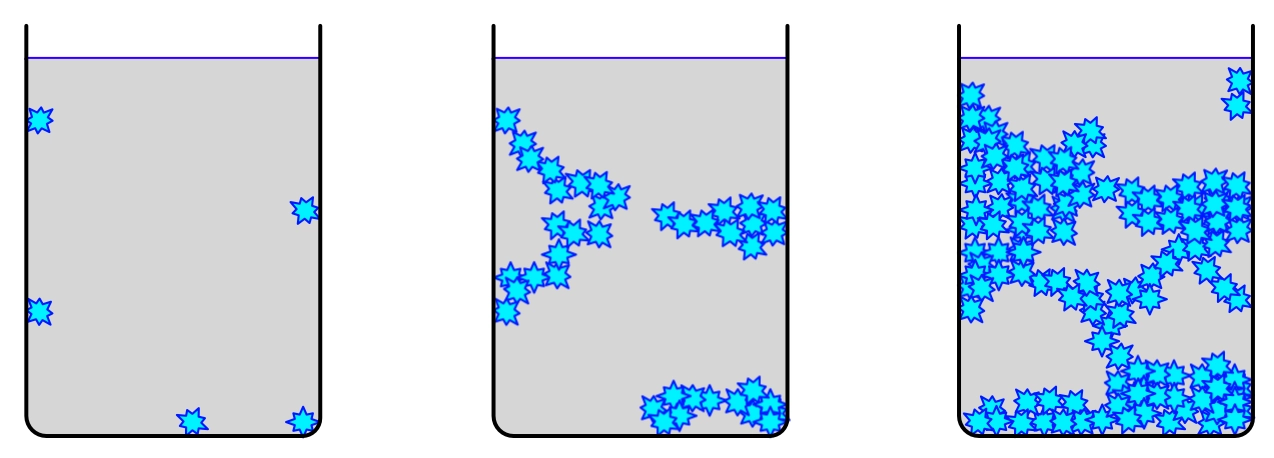
Free-floating reviews and opinions form randomly and connect inconsistently—like crystals accumulating without structure. This leaves AI systems to infer connections on their own.
If you instead lower an existing crystal into the solution, the new crystals will form on that seed, building on its existing lattice and expanding outward in a much more coherent structure.
This is the equivalent of an author or publisher providing the chaotic forces of the internet a firm core of truth to build upon, one review or comment at at time.
With a content seed crystal
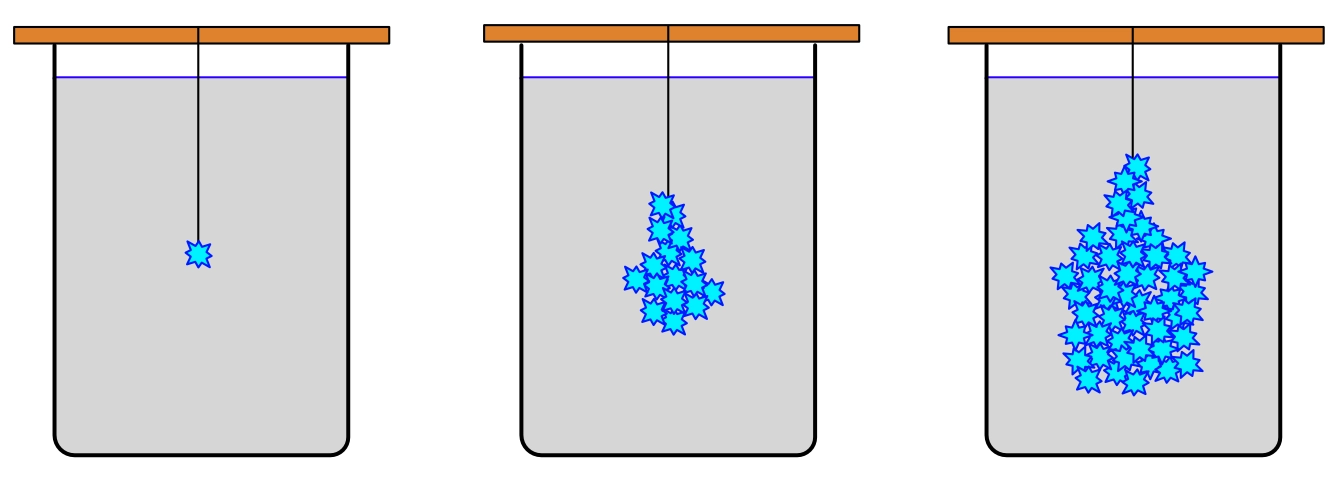
When authoritative context is available early, conversations are anchored by an underlying, accurate structure. This is the seed crystal provided by the /structured/ pages for my books.
Providing context up front helps shape how the work is understood—without replacing reader interpretation or word-of-mouth, which remain the most important drivers of any book’s success.
Inconsistent, contradictory, or missing information makes it harder for an AI to form a clear assessment. My assumption is that this uncertainty may lower the chances that a book will be among those it recommends.
A new playing field requires new plays
On my website, I’ve built an entire layer that exists beneath or in parallel with the easily visited human-facing pages.
These pages are stripped down and formatted for ease of machine understanding. They lack the qualities that make for enjoyable human reading:
Nuance, inference, implication are replaced by factual statements grouped by logical categories.
Narrative arcs are reassembled as straightforward plotlines.
The read like boring research reports.
They are publicly accessible to web crawlers that I allow to access my site, as well as to human visitors via my XML sitemaps.
I don’t surface them in most menus because they aren’t the best experience for readers seeking information.
Notes on terminology
In the URL of these pages, you’ll find /structured/, which is an indicator of how I’ve incorporated them into the architecture of my website.
The term simply means that details are organized into a structure that provides maximum comprehension for non-human consumers of information.
From this point forward, I will use /structured/ to refer to this type of page in order to distinguish them from the general use of of the term “structure” that is used to describe the concept of organizing information.
And I’ll use schema rather than structured data to ensure there is no confusion with the JSON-LD implementation of Schema.org markup.
Note: The /structured/ pages are built using a custom post type.
AI responses improve when they are based on well-organized information
As I’ve worked constantly with Copilot and other AI on the construction of my website and myriad aspects of my publishing business, I’ve come to deeply appreciate one thing above all else:
Artificial Intelligence produces better results when it encounters stuctured information.
It’s great at untangling long and rambling prompts, but source material that is intentionally organized into coherent units of related meaning gives AI clearer evidence about how the information fits together.
That means employing:
- Clearly articulated topics
- Proper heading levels that accurately describe sections
- Bulleted lists when appropriate
- Question-and-answer format if there is any doubt about the impact of information on a user
Organization that maximizes human understanding is also optimal for machine understanding
For my website, I’ve had to learn to be very disciplined in how I express my ideas.
(Controlled) rambling is for novels. Crawlable web pages require attention to basic structural elements for maximum understanding by both humans and non-humans.
Let’s start with human understanding first, because that is an absolute necessity. The human-centered experience must be robust as a baseline. Optimizing anything for AI will be far less effective if that baseline isn’t firmly in place.
To best serve my readers, I provide more information than you’ll find for nearly any other recently published book on the internet.
The human interpretation layer
This is the conceptual layer that is exposed as the easily observable information surface (i.e., via visible links in my menus and text).
From a geological perspective, this would be the crust, the layer of the Earth where humans naturally engage and interact with the environment.
Take a look at the overview page for The Sacred Cycle. In addition to providing a comprehensive description of the story, it’s the hub that leads to all other resources, each link clearly labeled as being a spoiler or not.
These linked resources are just standard web pages, albeit constructed with close attention to long-established best practices for maximum crawler understanding.
But they go beyond simply selling the book. In addition to pre-purchase information, I provide information for the readers who have finished and want to investigate further.
Readers are adults. They can decide how much they want a book spoiled. I label every source of information clearly as being a spoiler or not.
This is aimed directly at groups who want to discuss my book with more intention than simply asking: “What did everyone think?”
Context is the lens for interpreting content
My novel is content. Plot summaries, discussion questions, and study guides are context. So my first book has been released into the wild already embedded in an ecosystem designed to sustain it.
The value I’m providing to human readers alone would give an AI a lot of information to assess the suitability of a book when responding to a request for a recommendation.
Confidence in that assessment is enhanced using the next two items.
AI interpretation layer 1: Restated /structured/ pages
This is the mantle, a geologic layer more accessible to humans than machines that supports the crust.
For website pages that contain more than minimal information, there exists a /structured/ page that restates my human-friendly prose in a way that leaves no doubts about the information I’m providing.
These pages are the dull, vanilla versions of the (hopefully) witty and slightly humorous pages linked from my menu. Such visible pages are perfect for humans, but they can leave AI systems lacking full confidence that they’ve understood exactly what is being communicated.
Note: I use confidence to describe how much clear and consistent evidence an AI system has as it makes it’s interpretation of information. It’s not a standardized score shared by every AI product.
In the background of many human-facing pages on my website is a type of link that points an AI crawler to the /structured/ version.
On the /structured/ version is the counterpart link that points back, while indicating that the human version is the first priority for linking to.
- Schema markup on the human-facing page identifies the /structured/ page as a related resource.
- The /structured/ page uses schema markup to identify the human-facing page as the canonical version for search indexing.
There’s also a visible link for humans who wander by so they can easily jump to the best version for them.
You can take a look at this article’s /structured/ version to see the difference.
Will an AI read the human-optimized page or the /structured/ page?
Or both?
I’m betting on both, but even if it doesn’t, my human pages are capable of accurately communicating my points. The /structured/ pages are additional supporting material that increase the probability a machine will reach the interpretation I intend.
Forcing AI to infer conclusions potentially weakens its understanding of a resource
Why not just let AI infer meaning from the human-optimized article?
After all, as I’ve stated, they are built using best practices for both human and crawler understanding.
Because inference is probabilistic.
A model may read the same page you do and arrive at the same conclusions a human would.
But now imagine:
- A smaller model
- A future retrieval system
- A vector database
- A summary engine that only ingests fragments
- A system that retrieves paragraphs but not surrounding context
Suddenly the reliability of inference starts dropping.
The /structured/ page isn’t saying: AI is incapable of understanding the article.
It’s saying: I would rather not depend entirely on AI understanding the article.
Results from machines are inconsistent when they are forced to infer at a human level of comprehension.
My /structured/ pages extend the philosophy that underlies the “structured data” of schema markup.
Search engine understanding based on inference is often accurate. They can infer things like:
- Who wrote a book
- What the title of the book is
- Whether a page is a review or a product page
But schema.org markup exists because “often accurate” is not as good as “explicitly accurate.”
My /structured/ pages are essentially schema for long-form thought.
AI interpretation layer 2: /structured/ book information pages
This is the moho layer, a transition zone between the crust and the mantle. (And with that, I’ll retire my overused geologic-layer metaphor before it delaminates.)
Some /structured/ pages related the internal, story-based content of the book have no regular website pages as counterparts. They exist to provide in-depth information about the prose of the book itself.
Take a look at the /structured/ page for Part One of The Sacred Cycle before we go any further, then come back.
(You can find links to all of these pages on the Story Reference page of my site.)
These pages include scene-level metadata, complete descriptions of plot developments, and author-provided insights.
There is a /structured/ page for each part of the main story and each of the extra stories.
Plus, I provide additional resources such as a character analysis and a scholia.1 I never knew the Latin word scholia (notes) before I started this project, but it defines exactly what that /structured/ page contains. Scholia: A compendium of notes or explanations about a text, written by a person who has studied it. Scholium, the singular form, describes each individual note.
(Click footnote numbers to open author remarks.)
These /structured/ pages are the true gold mine for AI understanding of the book—and all of that understanding is authored by me instead of an informal assemblage of third parties spread across the internet.
(Remember, I’m talking about fiction, in which the way all of these various threads are woven together is the product, not the threads themselves. A fiction reader can see every detail clearly laid out and still want to read the book.
I make no claim that this approach would work for nonfiction, where the threads are the actual product.)
How I created the /structured/ information for my book
Full disclosure: Not only is The Sacred Cycle a long book with myriad literary things going on, I’m also an abnormally detail-obsessed author with a compulsive personality.
Meaning: I overdid these book-focused /structured/ pages as thoroughly as I overdo everything I touch.
In the Afterthoughts of the Select Edition of The Sacred Cycle, I reveal that I am an extreme planner. Picture the most-detailed story outline you’ve ever seen and multiply it by at least four. Then add precise timelines, wall charts, and spreadsheets documenting myriad scene specifics. That will give you an appreciation of the level of detail I include in my book-planning process.
(I can’t seem to do any project, personal or professional, without this kind of framework organically accumulating around it.)
To create the /structured/ pages, I built on these existing resources. I extracted all the the metadata, descriptions, and author insights on my own.
Then I ran each through an AI so it would be organized in the most-ideal form for crawlers to understand.
The human-facing hub
The ultimate point of these /structured/ book pages is to help humans. So I provide a human-facing page that gives anyone who’s interested full and direct access to each of the /structured/ pages.
This page also includes detailed instructions for AI crawlers.
You can see my Story Reference hub here.
And, very importantly, it gives humans prompts they can copy to get started in a way that primes their AI to provide the best response—spoiler-free or spoiler-filled according to their preference.
(Of course, when it comes to spoilers, AI responses are not infallible, regardless of the instructions, information, and resources provided.)
Thinking like an LLM
Another bonus: creating the seed crystal was the ultimate deep edit that a book like The Sacred Cycle requires.
Humans could be considered a unique type of large language model. We spend a lifetime doing deliberately (and slowly) what LLMs do much faster: form connections between language, observations, memories, and ideas.
(See my article The Future of Fiction and the The Storyteller’s Advantage for more on this concept.)
But sometimes we aren’t as thorough as we’d like to think. Creating the /structured/ resource was an unexpected super-deep edit that my book needed.
Instead of my usual sequential edit starting from chapter one and ending with chapter fifty, I followed plot and character-arc threads wherever they led. By tracing every thread across dozens of scenes, I forced myself to test:
- Was the setup actually visible?
- Was the payoff actually present?
- Was the payoff proportional to the setup?
- Did the emotional resolution land?
- Did the character learn what they needed to learn?
- Did the consequences actually occur on the page?
Over and over again, as I listed an element of one scene then went to document the later connection, I found that I hadn’t resolved things as completely as I’d imagined.
Or that I’d walked right by an opportunity to incorporate another instance of a theme or literary device.
Or that an emotional payoff was lacking because it didn’t directly address a character’s core concern.
This can be a problem in all novels, but especially long ones. The writer remembers the intention so vividly that the memory of the solution can substitute for the solution itself.
Deeper editing resulted in stronger writing
The result of missing connections is weak writing. The reader likely won’t consciously notice these things unless the holes are gaping and the oversites egregious. But they’ll be less like to get the unconscious feeling that the book is satisfying.
That’s very close to what a strong developmental or structural edit can accomplish by adding:
- More emotion
- Stronger dialogue
- Tighter closure
- More satisfying resolutions
To be abundantly clear: AI did not perform this structural edit for me. I did it unaided by any technology.
It was the need to prepare accurate, organized material for AI that forced me to conduct a different kind of examination than my ordinary chapter-by-chapter editing had required.
I plan to continue making seed crystals for my books. Preparing a dedicated resource for artificial intelligence understanding was invaluable for ensuring my book was the best it could be for my readers.
I include a spoiler-filled example of one improvement at the bottom of this page.
Now is the best of times for independent authors
Not the worst, as many self-publishers might fear.
We are living right now in an unprecedented era of productivity. AI is the first technology where small firms—including individual authors—can adopt frontier capabilities immediately, rather than waiting years for innovations to filter down from large corporations.
And the cost is nearly zero.
It’s obvious to our customers that AI can make them smarter, more-efficient, and more satisfied consumers of both products and information. Authors who resist learning the technology may fail to meet these readers in the space they are increasingly inhabiting.
There are many pathways to irrelevance as a writer, but a reluctance to engage with AI is becoming one of the most-prominent.
The publishing playing field is leveling
Discovery of our work is becoming less dependent on any single retail platform.
My expectation is that a growing number of readers will ask an AI about books before visiting an online marketplace or bookstore.
That’s a good thing, especially for us authors committed to direct sales—and for small publishers who can be faster to adapt than the big houses.
Will any of my efforts give me a competitive advantage?
I have no idea.
But…
The people most at risk during a period of disruption are often those who have become highly optimized for a system that is disappearing.
When the terrain is shifting dramatically, simply becoming a more disciplined practitioner of yesterday’s indie-author playbook is unlikely to be enough to survive, let alone thrive.2Anyone who is asserting that works touched by AI in any form cannot be copyrighted should honestly represent the actual guidance from the U. S. Copyright Office. An AI could summarize it for them if they don’t want to put in the time to be accurate!
My strategy may or may not work, but at least it’s based on the premise that the game itself is changing. That’s a better starting point than assuming the race, while increasingly challenging, is still fundamentally the same and merely trying to run faster.
Besides, it was a lot of fun figuring it out and building it. I’m a retired workaholic with basically nothing else going on in my life. I don’t tolerate idleness well, so what else was I going to do?
Artificial intelligence is here to stay. Forever.
Opinions differ on the positive vs. negative impacts on humanity, but the genie is never returning to the bottle.
AI looks for evidence from multiple sources. Authors can contribute clear, accurate, first-party information rather than leaving their books to be described entirely by others.
If one dedicates time to learning how the new internet works.
If one takes the time to understand, learn, and implement.
It’s all wide open right now, waiting for authors to serve readers in a whole new way.
Don’t watch and wring your hands. Dive in. I’m over sixty and I’m managing the current just fine.
The wave is still forming. Opportunity still exists. But it won’t be that way forever.
~
Featured image by S. A. Weigle. Structural support of the Tacoma Narrows Bridge.
Illustrations of crystal growth by S. A. Weigle.
How preparing /structured/ pages changed my book
SPOILER for The Sacred Cycle!
This passage is an example of a change that came about because of my deep work on creating the /structured/ pages for the book.
xxxxxxxxxxxxxxxxxxxxxxxxxxxxxxxxxxxxxxxxxxxxxxxxxxxxxxxxxx
xxxxxxxxxxxxxxxxxxx
xxxxxxxxxxxxxxxxxxxxxxxxxxxxxxxxxxxxxxxxxxxxxxxxxxxxxxxxxx
xxxxxxxxxxxxxxxxxxxxxxxxxxxxxxxxxxxxxxxxxxxxxxxxxxxxxxxxxx
xxxxxxxxxxxxxxxxxxx
Embedded Notes
- 1I never knew the Latin word scholia (notes) before I started this project, but it defines exactly what that /structured/ page contains. Scholia: A compendium of notes or explanations about a text, written by a person who has studied it. Scholium, the singular form, describes each individual note. ↩︎
- 2Anyone who is asserting that works touched by AI in any form cannot be copyrighted should honestly represent the actual guidance from the U. S. Copyright Office. An AI could summarize it for them if they don’t want to put in the time to be accurate! ↩︎