
WARNING: Significant spoilers for The Sacred Cycle
LET’S GET THE OBVIOUS FACT out of the way up front: I’m white. The character Crindi from The Sacred Cycle is black.
My premise from the start of learning to be an author has been this: I want to write interesting characters. I’ve never been interested in writing protagonists who closely resemble me in every respect.
So learning to write about all shades of skin was important, and I put quite a lot of thought into figuring it out. I learned an immense amount about characterization from carefully considering skin descriptions.
My biggest realization was that there are more aspects to skin than its color.
Creating realistic portrayals on the page takes a deep understanding of the ways all parts of a story interact with a reader’s perception of a character’s skin.
Note: All example passages with citations are from The Sacred Cycle.
Skin color significance depends on the character and the story
The Sacred Cycle isn’t about interracial dynamics. In the case of Crindi, it’s simply about an Egyptologist in London who happens to be a dark-skinned black woman.
But, while not involved in a story of racial dynamics, Crindi’s skin color is still more important than the skin of other characters, such as Angela’s or Ravi’s, because it holds an elevated status in the narrative.
This is an important consideration when considering how I described it.
The color of Crindi’s skin is deeply anchored to the Cycle
Teppi considers the color of Crindi’s skin to be representative of the divine, given the significance ancient Egyptians attached to the black mud deposited annually by the Nile River—so significant that they called their civilization Kemet (the black land) and clothed important gods in that color.
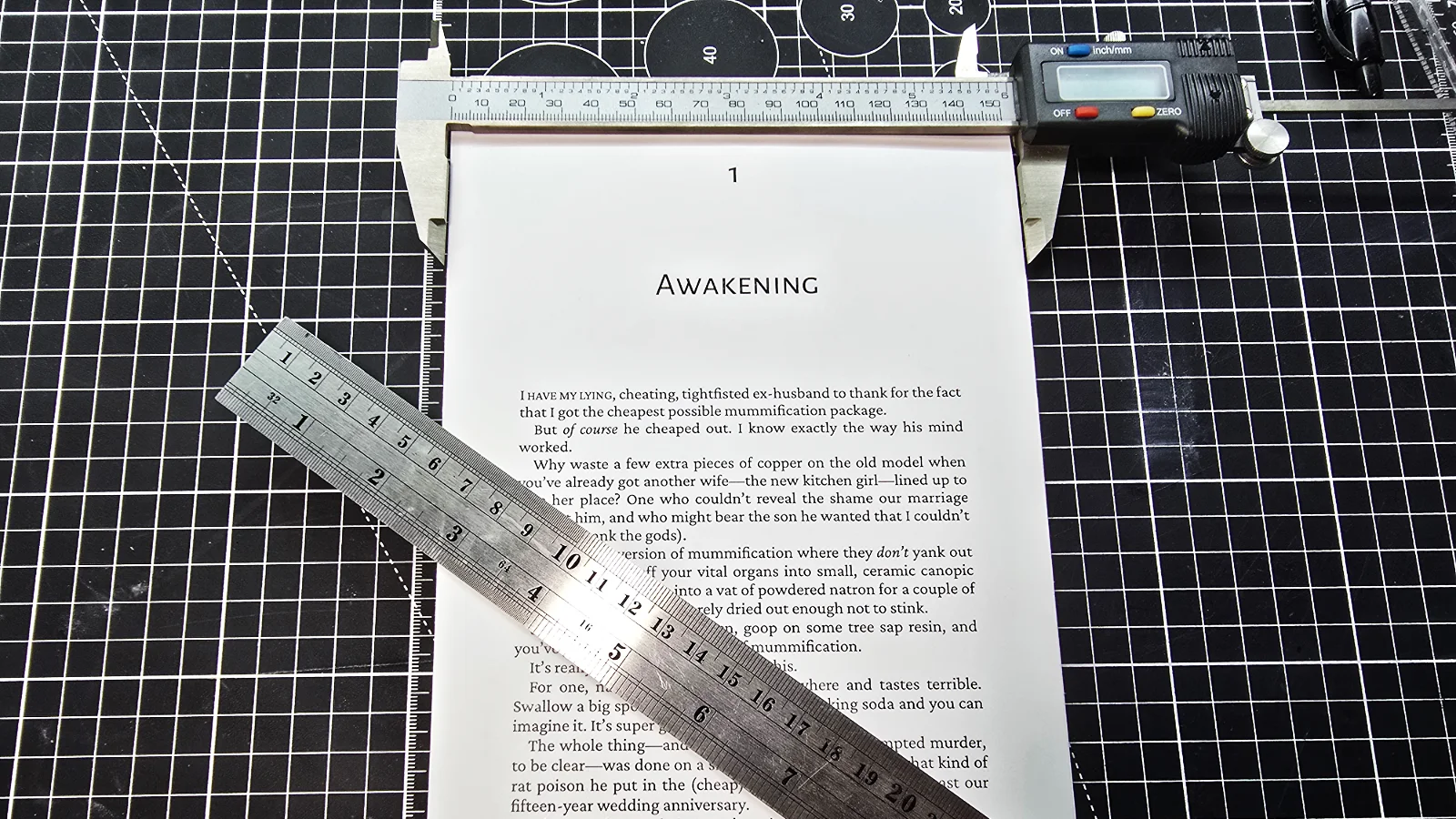
This didn’t occur to me when I wrote the opening scene in response to this assignment in an online course: Choose three words at random and start writing. 1The course was pre-recorded and self-assessed; no assignments were turned in.
(Click footnote numbers to open author remarks.)
Crind was just a black woman working in the British Museum basement since that’s what came to me in the moment.
But as I developed that opening in a full novel, the connection to ancient Egyptian beliefs were unavoidable, given that Teppi was my narrator.
The color of Crindi’s skin is magnified by Teppi’s perspective
The Sacred Cycle is a first-person narrative, and the first-person narrator is an ancient Egyptian who is captivated by Crindi.
Every word of the book is filtered through Teppi. This drives her immediate association of Crindi’s black skin with the religious beliefs that permeated every aspect of her ancient culture.
But for Teppi, there is another aspect besides her culture that is equally important: She’s immediately drawn to Crindi’s appearance from personal interest and only grows more interested as she gets to know her.
All other skin in the book is described matter-of-factly and briefly by Teppi. But not Crindi’s skin.
In Teppi’s narration, Angela’s skin is not quite as pale as Ollie’s, the first white person she’s ever seen. She notes it and moves on. Ravi’s medium-brown skin is described a grand total of once in the entire book.
But Teppi lingers on Crindi’s skin because she’s falling in love with her from the beginning, even if she’s too dense to realize it until Crindi lays it out for her in the last part of the book.
It would be a failure of characterization if Teppi didn’t repeatedly describe the way she’s seeing the woman she’s in love with, often with her own perception attached:
To my eyes, Crindi’s skin wasn’t just amazingly smooth, but her deep, rich, black tone was a much more beautiful shade than my lighter, medium-brown.
Chapter 12: Rituals > Scene A: The Nile and Crindi’s skin
~
Crindi looked up at me with her wide eyes, tears brimming over onto the beautiful, deep black skin of her cheeks.
Chapter 12: The Queen’s Walk > Scene B: The London Eye
These descriptions are saying as much about Teppi and her state of mind as they are about Crindi.
All characters are seen through the eyes of someone, whether it’s written from a first-person point of view or a third-person point of view. Forgetting that will flatten the characters into being of equal importance to the story. Remembering the impact of POV elevates all aspects of a key character’s appearance, and their skin is one of their most-important descriptors.
Let’s examine the ways a skilled narrative accomplishes that distinction for significant characters.
Skin comparisons
Using non-skin items to describe skin color is a nuanced topic. Discernment is required not only to avoid stereotypes, but also to avoid damaging the full context of the character being built. A few words of inapt comparison can overwhelm multiple other elements of character description.
This is especially true for comparisons of non-white skin to food. Food comparisons aren’t all the same, however.
But let’s start with the basics.
Comparisons may help reader perception
I don’t believe it’s necessary to always reach for alternate words to describe a skin color. The basic words can work fine: Black, brown, and white, combined with descriptors such as light, medium, dark, pale, etc.
Readers can picture a skin color without needing to compare it to some type of food or wood or other non-skin object.
But sometimes a comparison adds depth or nuance. Here’s Teppi talking about her own skin:
My skin appeared smooth, no longer affected by severe dehydration and a full-body, eons-long resin wrap. I was darker than I had been in my past life, more like the brown of the swollen Nile River during the flood, rather than the dark tan of wet sand. I liked the change.
Chapter 3: Teatime > Scene B: Teppi’s health update
She uses comparisons (muddy water, sand) that is natural for her to consider given her origin, and comparison/contrast adds more depth than simply saying her skin has grown darker.
If a comparison would add depth to a description, terms that are well-recognized as colors themselves (like sand) can work—meaning the term can be considered a specific color by ordinary readers without further explanation.
But food, as I mentioned before, is tricky.
Skin comparisons based on food
Food is used so often because food comes in many colors and humans are very focused on eating.
There are well-considered cautions about describing non-white skin using food comparisons since it can be exoticizing, as if a character is the living portrayal of the well-known nature of certain foods. I agree with this, as selecting certain foods damages characterization by flattening it into a single association.
A description such as “milk chocolate” is weighed down with the intense perceptions people associate with chocolate. This overweights the object of comparison, shifting narrative emphasis to the food and distracting attention from the character, even if in the author’s eyes it’s the perfect descriptive shade.
But some foods without associated perceptual baggage have become synonymous with a certain color, to the point where mentioning them makes a reader recall just the color, not the food it’s based on.
Almond, for example, or eggshell. Carefully considered, these can work without damaging characterization. Discernment is key.
Overreaching for comparisons
If the object of comparison itself must be described before it can be applied, then it’s a distraction, not a description.
Coffee, for example, isn’t a single color because people drink it all different ways across different cultures. Adding in the amount of cream needed to get exactly the color of your character’s skin usually means the comparison is distracting; the sense of taste shouldn’t be competing with the sense of vision.
The goal of a description is not to demonstrate the writer’s creativity. The goal is to help the reader form a clear mental image. When the comparison becomes more complicated than the skin being described, the reader’s attention drifts away from the character and onto the comparison itself.
Skin is lived in
Depth can be added to skin description by adding details that result from it being exposed to the rigors of daily life. To do this effectively, one can describe a part of the body other than the face, which is often the default focal point.
Hard work shows up in hands. Sun damage shows up on arms and necks. Outdoor activities leave their mark on legs.
Her brown hands showed the callouses from a lifetime at the loom.
~
He wore long sleeves to protect his tan arms, where years of sun exposure were evident in angry-looking, patches of reddish brown.
~
A mesh of fine lines covered the white skin below her knees, a result of countless summers hiking through the brambles and thistles that grew on the mountain.
And age eventually affects us all. From The Sacred Cycle:
The Professor’s nose and ears appeared to be a little too large for his deeply lined, pale-white face that was splotched with bits of red, purple, and brown.
Chapter 14: The Professor > Scene A: Teppi meets the Professor
Skin is associated with the sense of touch
Our sense of touch is transmitted through our skin, so it’s a natural companion for descriptions. Plus, we are used to sensing qualities of skin, including our own, by contact with it.
Different touch-based words can align with emotions. In her descriptions of Crindi’s skin, Teppi often combines the visual element with words such as smooth or satiny—terms that align with her tender feelings toward her flatmate.
Words like rough or coarse, by contrast, could signal a different emotion in the observer.
Skin can be descriptively contrasted
Here’s another description by Teppi after she notices that Crindi is wearing earrings near the beginning of the book:
She turned slightly, and the gold glinted in the light from the candle against her deep, black skin.
Chapter 3: Teatime > Scene A: The fate of the monkey
And later, much closer to the end:
She was even wearing the same gold ankh earrings, which still looked striking against her black skin, glinting in the glow of the streetlights.
Chapter 40: A Name > Scene A: Final tea and small talk
Contrasting skin color with the appearance of jewelry or clothing, or even tattoos, is a way to naturally including additional characterization as part of the description.
Perception of skin in different lighting
Differences in perception are easiest to imagine when the contrast is greatest: Black skin is a contrast to full light more so than white skin, and white skin is a greater contrast to full darkness.
So, when describing black skin in low-light conditions, an author might default to the white-in-darkness contrast and imagine that only eyes or teeth can be described.
But this mindset forgets a very important fact:
Novels aren’t movies where the visual representation is directly presented to the viewer.
Authors control what the reader “sees” in their mind’s eye, so they can paint whatever picture they want regardless of light conditions. There’s no need to focus on facial features (eyes, teeth) that aren’t skin.
And, again, POV matters. Teppi doesn’t need to actually see Crindi clearly because Crindi’s image lives in Teppi’s memory:
The image of her smooth, black skin and eyes shining charcoal in the subdued light lingered in my vision.
Chapter 48: The mission > Scene A: Crindi makes a plan
Even movies do this; no matter how dark the deepest cave is, movies rarely show a completely black screen.
Caution: Skin reactions can weaken emotional scenes!
After a few rounds of editing, I noticed that I was shortchanging Angela’s emotional scenes by constantly using blushing to indicate a changed emotional state.
In spite of what I’d figured out about describing darker skin tones, I’d completely neglected to apply the same care with light skin.
Light skin’s variability based on blood flow can be an easy trap to fall into, and it diminishes characterization.
Because Crindi’s skin is too dark to noticeably change shade due to emotion, I had to pay closer attention to describing her state of mind and how it manifested in her actions and words. This gave much more depth to these moments.
But initially, all Angela (a white character) got was blushing no matter what she was feeling—embarrassment, discomfort, shame, it didn’t matter. Same reaction every time.
It was lazy writing.
Mannerisms convey more emotion than blushing
When I limited Angela’s blushing to a single incident—her deep shame over how she’s treated Teppi and her extreme discomfort with asking Teppi for help with her thesis—her other scenes became much more emotionally powerful.
Like I had done with Crindi, I focused instead on her mannerisms, dialogue, and expressions, which communicate emotional state more effectively than blushing since they combine non-skin reactions that are readily visible to observers.
Here’s a description where I removed blushing and added hesitation, swallowing, and freezing as more robust manifestations of embarrassment:
“Maybe we could take Teppi on another field trip? For her studies.” Crindi’s eyes widened. Angela swallowed, then pushed on. “It might be, uh… educational.” She glanced briefly at Ravi. “You, too.”
No one spoke. For a moment, I thought Crindi would spontaneously combust from joy. Work friends were transforming into real friends right in front of her and Angela—Angela!—was the catalyst. Her lips moved but no sound came out.
Angela stood frozen, exposed like a burglar caught in a floodlight, obviously desperate for someone, anyone, to speak.
Chapter 28: Westminster > Scene C: Khepri and Teppi
This paints a much more vivid image than simply altering the color of her cheeks.
Skin is in the eye of the beholder
Returning to Teppi’s fixation on Crindi allows me to demonstrate all of the aspects of skin discussed above, but also to illustrate the role it can play in bringing the characterization of the observer, not just the observed, to vivid life.
Reading nothing but these description, listed in order from the beginning of the novel to the end, what sense do you get of a gradual change in Teppi’s feelings toward her flatmate?
She’d rolled up the sleeves of her white lab coat, pulled safety goggles on over her afro, snugged them over the look of focused concentration on her deep-black features… and started piercing my belly with a drill…
Chapter 1: Awakening > Scene A: Teppi Awakens
~
Her deep-black cheeks were framed by the tight coils of hair escaping from her cap.
Chapter 11: London > Scene A: Teppi and Crindi set out
~
Her satiny, black skin was dappled in sunlight filtered through leafy, green trees and wisps of her natural hair stirred in the breeze.
Chapter 26: Turning Point > Scene A: The park bench
~
Moonlight bathed the smooth, black skin of her face in a soft, ethereal glow. Her black braids lay against her neck, moving slightly as her chest slowly rose and fell.
She was so beautiful, from the outside to the inside. (…) I found it impossible to look away.
Chapter 44: The Truth > Scene B: Crindi explains her love
~
She was an angel. She was my angel. Her blessed skin, divine and pure, was bathed in the glow of the dropped flashlight, and her braids were backlit by moonlight.
Chapter 49: Past is Present > Scene A: Teppi collapses the chamber
Skin is an amazing aspect of a story for multiple reasons, and it deserves the utmost care by any writer seeking to bring characters to vivid life for readers.
~
Featured image by S. A. Weigle. Pebbles on a driftwood log. Tacoma Narrows Park.
Embedded Notes
- 1The course was pre-recorded and self-assessed; no assignments were turned in. ↩︎