I DON’T LIKE SPOILING MY OWN WORK, so it was a nonstarter to provide content warnings printed in my books that give away elements of the plot.
I also don’t think it’s appropriate to advise readers of specific things they may find uncomfortable purely due to religious, political, or other deeply held beliefs. These things, should they exist, are part of the story being told. After all, an author making a reader uncomfortable has been an intrinsic part of novels forever.
But I still wanted readers, parents, and librarians to know enough about the presentation of the story to make a fast decision as to whether they want to look deeper or move along.
Content ratings are used on video games, movies, and music without any complaints of spoiling them, and have been for years. There’s no reason a rating system can’t do the same thing for books.
So, I set out to create one.
Readers hate unpleasant surprises
One of my favorite hobbies is reading the one-star Amazon reviews of bestselling books. I do this to understand what concerns ordinary readers have that cause them to dislike a popular book so intensely.
It’s rarely about the subject matter; rather, it’s usually about how the story is presented.
Readers often don’t have much to go on when choosing a book from an online store: a brief description, blurbs from reviewers, and a relatively small number of pages to sample. They often feel misled into wasting both time and money on something they would much rather have avoided.
Of course, it’s common for reviewers to talk about plot holes, or flat characters they couldn’t grow to like, or vague endings with no resolution.
But often, the single-star is based on readers being dismayed, angered, or disgusted with an author’s choice to use foul language, gratuitous violence, or (sometimes disturbing) sexual encounters.
Two approaches to cover all concerns
I was already planning to provide extensive descriptions that a reader can choose to read or not, as well as four sample chapters. Those who are really concerned can even read a summary of the entire plot.
But that’s not enough.
Based on these one-star reviews, I knew I was still missing a direct statement about what kind of language or scenarios they will encounter throughout the entire book.
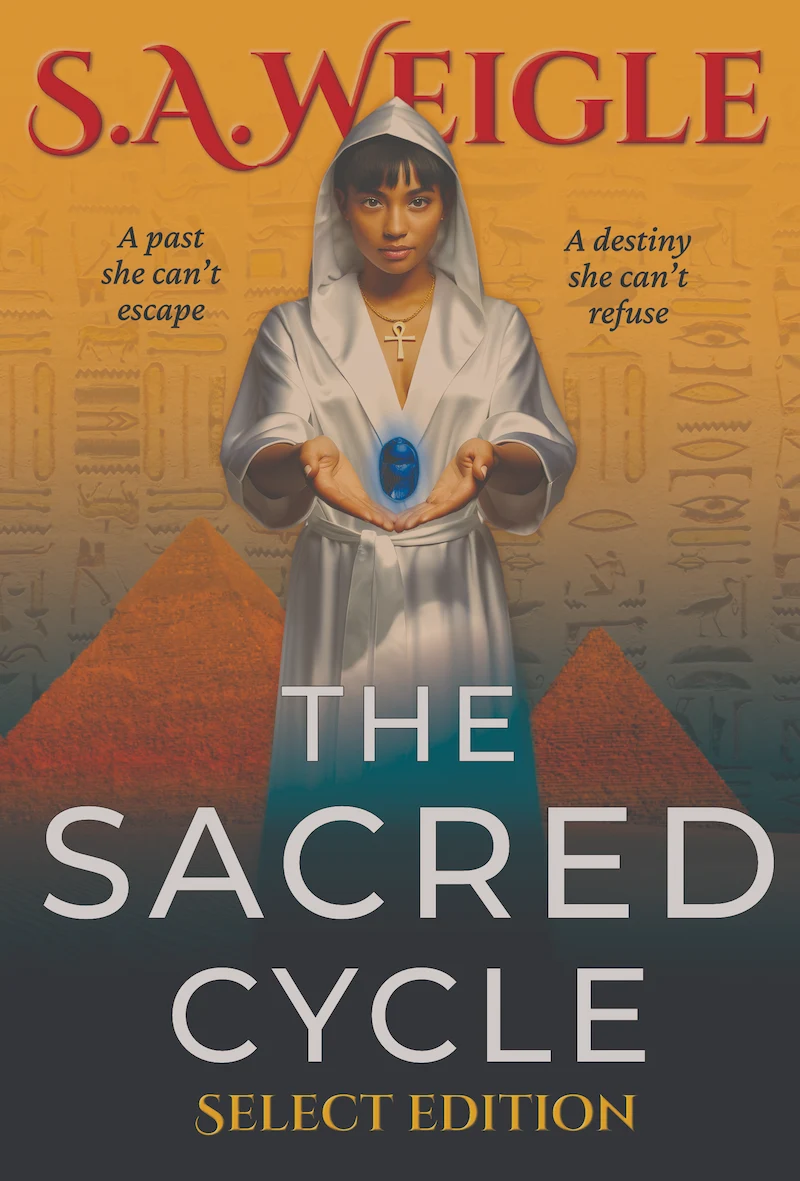
So I developed my own rating system to fill in that blank. Look at the rating page for The Sacred Cycle to see an example of it in action.
A single rating number is needed
After researching different ways of rating content, I knew that whatever system is used, it somehow has to be expressed in a single number or label; the equivalent of G, PG, or PG-13 for movies.
I decided that a minimum reading age would be my “label,” rather than a blanket one like “All Ages” or “Explicit.” Plus minimum reading ages are already implied when books are grouped into categories like middle grade or young adult by librarians.
But I wanted to provide more context than that, because in a novel, there can reasons other than language or graphic imagery that determine reading age.
Here’s the full rating scale for each of the categories below:
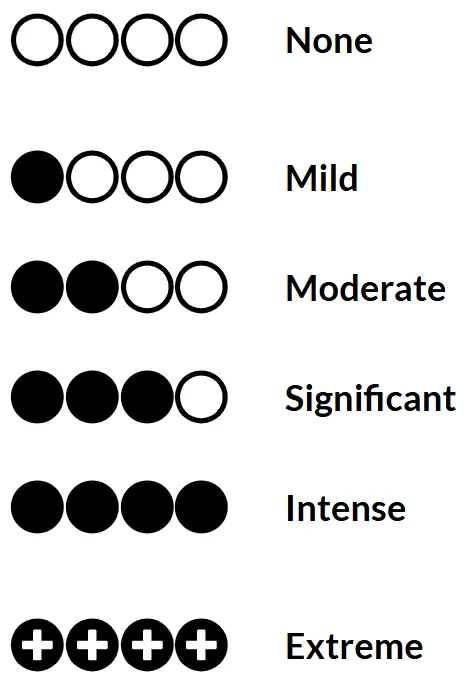
The components of the rating system
Here’s what I came up with and my reasons for including each element of the rating.
Language
The first of the big-three concerns.
I think leaning on cursing to establish a character’s personality or just to be edgy weakens my writing, so at this point at least, I’ve decided not to include much of it.
I rated The Sacred Cycle “mild” in this measurement with the explanation:
“Curse words that would be unremarkable in casual conversation.”
Intimacy
The second of the big-three concerns.
I chose “intimacy” so I could rate the entire scale of partner relations, from hugging all the way up to the most explicit sex. Not that I plan to write any of that, but I needed to take into account the things readers are considering in order to establish a proper range.
I rated The Sacred Cycle mild:
“Minimal non-sexual situations.”
Violence
The third and final of the big-three concerns.
We all know what this means. I think for this item, one must consider frequency and method of portrayal as much as the act of violence itself.
There’s a difference between a detective story with one messy crime scene at the beginning and one about a serial killer that includes three, four, or more.
And there are ways to distance the reader from the immediacy of violence. Even the most-horrific act can be included as backstory without making a reader wade through each punch, kick, and gunshot.
I think a well-considered rating method must capture this nuance.
For The Sacred Cycle, I chose “moderate” for violence:
“Short violent incidents, both off-page and directly described.”
(Off-page means a recounting of what happened without extensive details.)
Peril
I am very sensitive to characters being put in perilous situations in movies and videos.
I know this may be odd for a novelist who can write them just fine, and in fact enjoys the challenge of pushing characters to the very edge of uncertain outcomes. But in my personal life, I’m much more likely to choose animated shows or anime where I know I’ll generally be safe from excessive peril even if endings aren’t always happy.
Maybe it’s seeing actual humans under stress? I’m not sure.
(Again, it’s an odd reaction for an author; I don’t even consider watching horror, but I have a great premise for a psychological horror book documented already.)
So I’m very aware of the impact that characters in peril can have on a reader’s—especially a young reader’s—enjoyment.
I rated peril in The Sacred Cycle as being “moderate” due to:
“Instances of uncertain outcomes with substantial personal risk.”
Complexity
I knew this had to be rated in my stories after I finished my draft of The Sacred Cycle. A woman from the remote paste observing modern society opened up far too many opportunities for cultural commentary for me to resist.
It got complex. Very complex.
A long novel gave me plenty of room to approach such subjects in bits and pieces to bring the reader along with full understanding. But even such an approach didn’t reduce the complexity of the themes themselves.
I couldn’t imagine an eleven or twelve year old, no matter their reading level, following the eons-long strands that comprise the development of human civilization since their background knowledge is limited. I’m sure these young scholars exist, but I would have been hard-pressed to follow such concepts at that age.
(At least if it wasn’t expressed as science fiction; the existence of spaceships always did wonders for my concentration.)
I rated my first book’s complexity as “significant,” with this explanation:
“In-depth historical/philosophical discussions of abstract ideas.”
The final content rating number
There’s no averaging system. Just my judgment after working through my rubric. I hope readers will come to trust that judgment over time.
Again, jump over to the rating page for The Sacred Cycle to see the full rating ranges and my clever graphics.
Reading level isn’t rated
The text of The Sacred Cycle averages about a ninth to tenth grade level. This happens to match my rating of 15+, but it’s just coincidental. Readers, parents, and librarians are the experts at assessing text complexity when they make decisions. There’s too much variability in individual ability for me to include this measure in my scale, and reading level is an unreliable indicator of content anyway.
Building trust one reader at a time
Every decision I made about how to present my first book came down to this:
What would I want to know if I encountered a brand new book from an unknown author?
My rating system is part of building trust in my author brand, so that when readers see S. A. Weigle, they know they can rely on my judgment as much as on my writing skill.
~
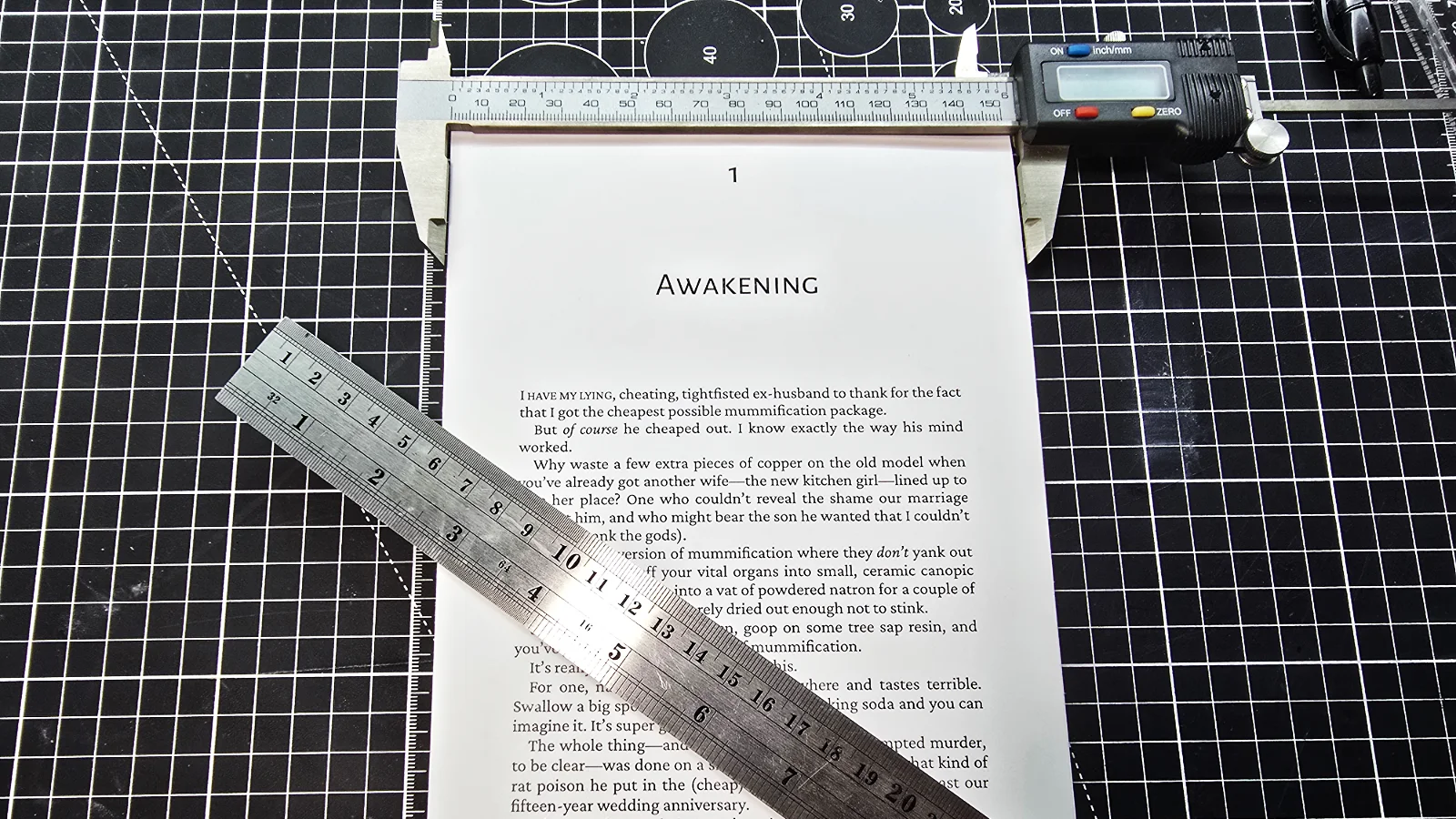
Featured image by S. A. Weigle. Manuscript and measuring tools arranged on my workbench.