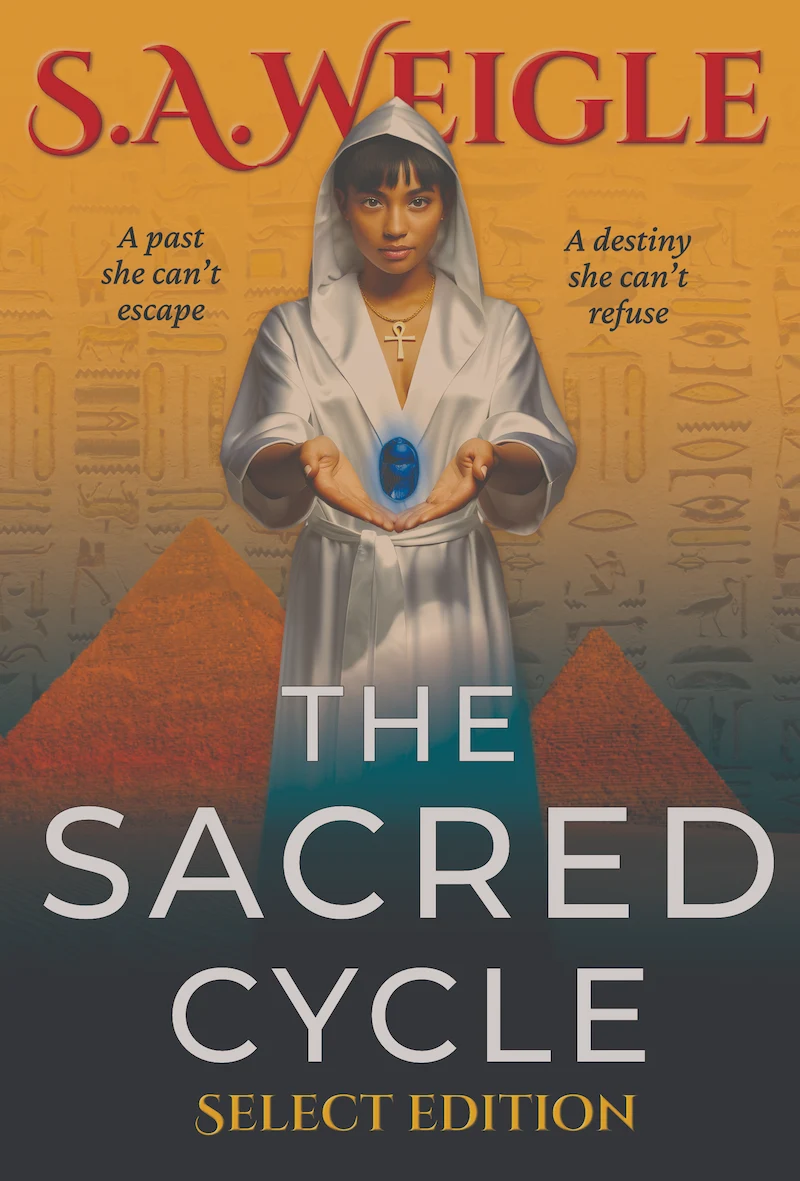
MY FIRST BOOK, The Sacred Cycle, is for readers aged fifteen and above, according to my own rating. That’s a high school freshman in the United States.
What’s the reading level? For at least 90% of the book, it tops out at 6th grade—age eleven or twelve.
That’s even below the average reading level of American adults, which is 7th to 8th grade.
That doesn’t seem right, does it? How can a “book-club book” that dives into ancient Egyptian societal structures and modern cultural issues be written for eleven year old kids?
Because, of course, it’s not.
Reading level—as in the actual decoding of text—has very little to do with the sophistication of the ideas presented.
It’s mostly about sentence length and paragraph length.
Authors who unintentionally misuse commas limit their audience, sometimes drastically.
And a lot of readers lose out when authors bury their points in run-on sentences and half-page paragraphs.
Changing lives one sentence at a time
What’s my ultimate goal?
I’m trying to change the world in my own small way with my books. My writing style may not be for everyone, but I try not to exclude readers by burying my points in convoluted prose.
Authors must think carefully about who they want to influence, because that decision determines how best to communicate with them.
Dialing difficulty up and down is easy
Read this:
In a meadow laying fresh on a hillside in the Italian countryside, where the spring rains had only recently given way to clear skies and warmer days, wildflowers spread across the grass in broad bands of red and yellow and violet. The air carried the mingled scents of damp earth, new growth, and distant groves of olive trees, while swallows wheeled overhead in looping patterns above stone farmhouses, terracotta roofs shining in the sunlight. Beyond the meadow, vineyards climbed the lower slopes in orderly rows that seemed to draw the eye toward the hazy blue hills on the horizon, where small villages nestled among cypress trees and church towers gave refuge to unseen malice. Everywhere there was movement: in the insects drifting from blossom to blossom, in the long grass bending beneath a gentle breeze, in the branches of fruit trees trembling with newborn leaves.
► Reading level: Beginning Master’s degree—ages 24 and beyond, according to Microsoft Word’s built-in checker.
Now read this version of the same passage:
A meadow lay fresh on a hillside in the Italian countryside; spring rains had only recently given way to clear skies and warmer days.
Wildflowers spread across the grass in broad bands of red, yellow, and violet. The air carried the mingled scents of damp earth, new growth, and distant olive groves.
Swallows wheeled overhead in looping patterns above stone farmhouses. Terracotta roofs shone in the sunlight.
Beyond the meadow, vineyards climbed the lower slopes in orderly rows. They drew the eye toward hazy blue hills on the horizon, where small villages rested among cypress trees and church towers.
Everywhere there was movement:
Insects drifted from blossom to blossom.
Long grass bent beneath a gentle breeze.
And the branches of fruit trees trembled with newborn leaves.
► Reading level: 6th grade (American)—ages 11 and 12
The reading level dropped by 12 years simply because I used more periods and shorter paragraphs.
Same information. Nearly the same words. Far easier to read and understand.
Normal readers like normal writing
I know which one of those two passages the vast majority of readers prefer, which is why I write that way. I want a lot of readers to enjoy my books, and I want those readers to absorb some serious ideas.
That’s not “writing for the lowest common denominator.” It’s writing for a wide audience. An audience that deserves life-altering literature as much as anyone else.
The harder you make your ideas to absorb, the more people you exclude from considering those ideas.
Too many long sentences throttle comprehension
Longer sentences are often found disproportionately in novels considered to be of a “literary” type, although that’s not a well-defined genre. Roughly speaking, it’s the type of books commonly associated with prizes such as the Booker Prize and Pulitzer Prize, as well as Masters of Fine Arts courses.
I’m not anti‑literary-novel. Not at all. Some readers (and some award committees) like longer sentences and paragraphs. I’m pro-reading in any form, so readers should get what they like.
I’m not even anti-long-sentence. I use them all the time. It’s the frequency of such sentences that can have unintended effects.
What I’m anti is the assumption that more difficult prose is inherently better prose.
A style that works well for a Booker Prize contender may be poorly suited to a novel intended for a broader audience.
Literary fiction isn’t very popular with commercial audiences
Which, some might say, is exactly the point.
But it’s safe to say that literary fiction appeals to a smaller readership than many of the largest commercial fiction categories such as romance, fantasy, mystery, and thriller—genres that can also transmit life-changing ideas.
In short, most fiction readers don’t buy those prize-winning books.
If an author’s aim is reaching “most fiction readers,” she shouldn’t exclude them by either intentionally or unintentionally writing in a style that turns them away.
Raising perceived reading level through complex prose constructions often doesn’t elevate ideas—it smothers them.
Italian meadows don’t become more beautiful simply because the bucolic descriptions have all been strung together into ultra-long sentences.
Long paragraphs should be tools, not accidents
Here are good reasons to use long paragraphs:
1. Slow the reader down so they fully absorb an important point or emotional moment.
2. Make the reader skim so the author can hide a foreshadowing clue in the middle of a long paragraph so they aren’t just pulling a twist out of thin air.
(Quick: Tell me what’s unsettling about the Italian countryside. Or do you need to read the first passage again without skimming?)
There are other good reasons, but this isn’t one of them:
3. The author only haphazardly uses the enter key.
Paragraph length is a significant driver of pacing, and therefore a critical tool for adjusting pacing at the scene level.
(I go into this at great length in the Study Guide for The Sacred Cycle using examples from the book to illustrate.)
When it comes to writing clear, comprehensible text, the two most-important keys are period and enter.
Mobile-optimized reading
I like to meet the reader where they are, and where many of them are is on phones.
People squeeze in reading where they can and lugging a book on the train isn’t convenient. Even an eBook or a tablet isn’t always part of a commute or vacation hand luggage.
This maybe seem obvious, but I think a lot of writers forget a basic fact:
Narrow screens make short paragraphs longer and long paragraphs a wall of text.
If you only consider printed pages, you risk losing a lot of modern readers.
My goal is to write books that are so enthralling that people can’t stop reading them no matter where they are. I want them to have the best-possible experience whenever they encounter S. A. Weigle, so mobile-screen presentation is always on my mind.
Readers deserve intentional writing
Many a writer’s style is to go with the flow when they’re writing. My style has flow, but it’s also relentlessly analytical.
It’s the way my brain is constructed.
Using my project-management skills, I analyzed my way to learning how novels work and how to write them for maximum effectiveness. That may not be a common approach, but it does position me to explain exactly why I’m doing anything on any page.
I can talk about my word choices, foreshadowing, use of metaphors, or any number of other parameters of gripping writing—including the length of my sentences and paragraphs.
I can tell you why I’m doing everything in my books because I’ve set for myself a lofty goal.
I want to change lives with my writing
As we discovered during our stroll through an Italian meadow, readability level can be dramatically altered with a few adjustments. Adjustments which can either elevate or obscure meaning.
It’s an approachable readability level that allows me to discuss complex topics in easy-to-understand ways.
And discussing complex topics is how perspectives—and lives with them—are changed. One ordinary reader at a time.
~
Featured image by S. A. Weigle. Sticks and stones arranged on a beach. Tacoma Narrows Park.